
This blog covers my adventures in reading, writing, procedural content generation, and whatever else comes to mind.
Showing posts with label science. Show all posts
Showing posts with label science. Show all posts
Tuesday, November 28, 2017
Link: Genetics and Extinction
Author and scientist Cedar Sanderson has an interesting blog post today about genetic paucity and extinction. I found it quite fascinating, and worth a look.

Monday, November 27, 2017
Terminal Moraines
This is just a brief musing on the impact of glaciers on terrain. I won't go getting into the science of it too much, but glaciers can create or alter terrain features in interesting ways - in addition to being terrain features in their own right. One of the features they leave behind after they retreat are terminal moraines.
Moraines are masses of rock that the glaciers convey to their edge. The rocks vary in size, all the way down to the size of gravel and sand, and they accumulate. When the glaciers retreat, the accumulation that is left behind forms a hill or ridge.
On an otherwise relatively flat landscape, such a hill or ridge could stand out. It need not be uniform, especially after erosion may have redistributed it. So you can get irregular or lumpy ridges. Or a collection of hills. Or, if moraine was left in what is now a lake or sea, islands. Many of the islands in Long Island Sound are the remnants of the terminal moraines from the last glacial maximum. Some are not though, the Thimble Islands for example being the remnants of rocky hills that were partially ground away by glaciers.
Moraines are masses of rock that the glaciers convey to their edge. The rocks vary in size, all the way down to the size of gravel and sand, and they accumulate. When the glaciers retreat, the accumulation that is left behind forms a hill or ridge.
On an otherwise relatively flat landscape, such a hill or ridge could stand out. It need not be uniform, especially after erosion may have redistributed it. So you can get irregular or lumpy ridges. Or a collection of hills. Or, if moraine was left in what is now a lake or sea, islands. Many of the islands in Long Island Sound are the remnants of the terminal moraines from the last glacial maximum. Some are not though, the Thimble Islands for example being the remnants of rocky hills that were partially ground away by glaciers.
Monday, November 20, 2017
Genes for Longer Life?
Scientists recently published a paper about some interesting genes found among the Amish of Indiana. Those who possess the genes tend to live 10% longer than those without. Very interesting stuff, especially given the recent experiment with in vivo genetic engineering in humans.
Thursday, November 16, 2017
Geology-related Travelogue
Over at Cat Rotator's Quarterly, Alma Boykin has a couple recent posts on a trip between Amarillo, TX and Albuquerque, NM. While the space in between is in many ways very boring, Ms. Boykin's post covers some of the interesting geology and terrain features of the region.
Wednesday, November 15, 2017
Real-life Genetic Engineering in a Live Human!
The Associated Press report that US scientists try 1st gene editing in the body. This pretty exciting news. They're actually trying to cure a disease called Hunter syndrome in a 44 year old through gene editing.
Thursday, April 20, 2017
This May Khipu Occupied for a Bit
National Geographic has reported upon recent discoveries related to the Inca khipus. It is hoped that the recent finds may eventually help unravel the information encoded into the braided strands. The article may khipu keep you occupied for a brief bit.
Thursday, March 30, 2017
First Falcon 9 First Stage Reuse
I was reading space.com this evening and was intrigued by their coverage of the successful takeoff, deployment, and recovery of a SpaceX Falcon 9 first stage. SpaceX has done that before, but what makes today's story exciting is that this is the first time a used Falcon 9 first stage has flown. This same first stage launched a Dragon cargo capsule toward ISS back in April 2016; today it flew again and launched a satellite. Congratulations to the SpaceX team on this historic accomplishment, and kudos to space.com for the nice coverage.
Wednesday, March 29, 2017
New Battery Technology
Over at Peter Grant's blog mention was made of a new battery technology. The article that was linked to describes the new technology as the work of a team led by 94-year-old John Goodenough, co-inventor of the lithium-ion battery. The inventors claim the technology is safer (less combustible), faster charging, has greater energy density, and a longer life (number of charge/discharge cycles). If it pans out that'll be quite an improvement. I guess Goodenough decided the lithium-ion battery wasn't good enough.
Monday, March 27, 2017
A Tasteful Post
Sunday, March 19, 2017
Sunday Trailer Progress
I made much progress today! The replacement piece I mentioned yesterday, and its smaller friend I fabricated last week, were installed, along with the piece of channel that belongs at the edge of the floor. Before and after photos, though not from the same angle, can be seen below.
A bit of interesting (at least to me) science: The areas in red circles in the "before" photo show up as shiny in the "after" photo, because the aluminum alloy of the new pieces is much shinier than the 68-year old pieces adjacent to it, which have oxidized to a dull gray. Iron oxidize to form iron oxide, the reddish material we call rust, and will continue to rust away without further treatment. The surface of aluminum oxidizes to a thin layer of aluminum oxide, but that layer protects the unoxidized aluminum below. This is why unpainted aluminum trailers, like Airstreams, are often polished - but must be treated with a protective sealant or repolished periodically. Polishing removes the layer of dull gray aluminum oxide to reveal shiny aluminum again, but the cycle of oxidation will start afresh without added protection. It should be noted that the older aluminum trailers (Airstream and contemporary imitators) could be polished to a much higher shine than modern Airstreams because they were skinned with 2024 Alclad, in which a sheet of 2024 alloy aluminum is coated with a very thin layer of pure aluminum. Modern Airstreams are produced with, IIRC, 3003 alloy aluminum, which aren't as shiny, but still have a pleasant sheen.
 |
| March 5, showing damaged sections and opening |
 |
| Today, with replacement sections in place and skins reattached |
To get the skins reattached involved much drilling and temporary attaching if aluminum pieces via small devices known as clecos (named for the Cleveland-based company that created them), or panel holders. Nearly every hole has a cleco installed in it to make sure everything lines up. After everything was checked and double checked, most of the clecos were removed and a polyurethan-based sealant was applied where the panels were to join. Then I used Olympic rivets, a blind (pop) rivet that mimics the look of the solid (bucked) rivets used elsewhere on the trailer's exterior. Each rivet got a dab of the sealant on it to make sure it sealed watertight upon installation, and excess sealant along panel seams and at rivet holes was wiped away using rags wet with mineral spirits.
 |
| Aluminum skins temporarily attached with clecos. Note the annoying dent in the panel is still present, though much reduced from when I first acquired the trailer. |
Alas, I have no pictures to show. I finished up about 9 PM, long after darkness had set in, and just a few minutes before the battery-powered work light ran out of juice. I still have to go back and cut off the remnants of the rivet shafts then apply a special tool to clean up each rivet head. I could have grabbed a fresh battery or an extension cord and kept working, except the special tool would make a lot of noise and I don't want to be the noisy neighbor.
If weather cooperates I may get that done tomorrow. If the weather is warm but rainy I will likely only be priming the steel; that steel needs to be primed and painted before the wheel wells and next section of plywood floor can go in. If it is especially cooperative I may be able to also address that ugly temporary patch you see on the right center of the above photo, and replace it with a real patch made from aluminum. The patch that had been there before, that came with the trailer when I purchased it, had been extremely battered so was removed.
It is starting to feel like I'm making real progress again. By the end of April I hope to have all of the new plywood floor in and the trailer weather-tight again, something it hasn't been since who knows when. Then comes all the rest of the stuff to turn it into a road-worthy trailer and a viable camper: brake lights, wiring and electrical, insulation, the minimal plumbing, reinstallation of the inner skins (inside walls), and the furniture. Whoo! That's a lot of work still to be done, but weatherproof and a good floor will go a long way to making that possible.
Friday, March 17, 2017
Food and Farming
Cedar Sanderson has recently written a series of blog posts on food and farming. I found them interesting and thought provoking. They were about Persistent Food Myths, the Future of Farming, and Monoculture, Agriculture, Permaculture.
Thursday, March 16, 2017
This One's a Real Gem
Crater of Diamonds State Park in Arkansas is fairly small as state parks go, but it is also unique among state parks. It is a gem mine open to the public for a small fee. Originally a commercial mine site, it was the source of the largest diamond found in North America, but was not very profitable, and it was sold to the government of the state of Arkansas in the 1970's or 80's and turned into a state park. For a small fee the gem field is open for searching and digging by members of the general public, and it produces not just its namesake diamonds but a wealth (pardon the pun) of other gem stones. A teenager just discovered a 7.44 carat diamond there. The local news in the area covered the story. Neat.
Wednesday, March 15, 2017
Volcanoes and the Habitable Zone
I was reading space.com earlier and saw an article about how volcanoes can impact exoplanet atmosphere and climate. While I suppose most are familiar with the impacts volcanic eruptions can have here on earth (if you're not, check out 1816, the Year Without a Summer, for an example), what the article is discussing is somewhat different. Instead of dust clouds it is concerned with hydrogen released by substantial volcanic eruptions producing an atmosphere that allows a planet to retain water across a larger distance from its star. Essentially, enough hydrogen in the atmosphere expands the habitable zone outwards. The article discusses some possibilities with respect to the recently-discovered TRAPPIST-1 system, which discovery I mentioned in an earlier blog post. Very interesting stuff.
Tuesday, March 14, 2017
Don't Get Pissed
Space.com has an article about German researchers are looking at how to grow tomatoes in urine to keep crews fed on voyages to Mars.
Saturday, March 4, 2017
Glyptodons Three
Last week a wrote a post about the glyptodon, after encountering them for the first time (so far as I recall) in a click-bait article that day. Earlier this week I saw a mention of them. Then came today. Blogger, historian, and author Alma Boykin (TXRed) has a fascinating blog post today (After the Ice Retreats: What comes Next?) that makes mention of "armadillos the size of a VW Bug," likely a reference to the glyptodon. Check out her post if you want to learn more about what the land might have looked like in the wake of the retreating glaciers as the Pleistocene drew to a close.
Thursday, March 2, 2017
Better Thawing from Cryofreeze
Scientists have found a better means of thawing tissues that have been cryofrozen. Cryogenic preservation of tissue has been shown to work in the past, but thawing the frozen tissue without damaging it had previously been impractical for tissue volumes greater than about 1 mL. As the news article and journal article on this experiment make clear, the new technique was able to thaw tissue volumes of up to 50 mL. At that capacity it won't be used to thaw humans - but it could do wonders for the organ transplant situation. Currently many organs go to waste because they can't be kept on ice very long to allow transport to those who need them. This technique has the potential to change that. Also, they think it could scale up farther. Awesome!
Wednesday, March 1, 2017
Glyptodon Redux
Twice in as many weeks, I've encountered a reference to the once-mighty glyptodon. That now-extinct genus were like giant armadillos. They were extant through toward the end of the Pleistocene, but went extinct like many other megafauna sometime between the late Pleistocene and early Holocene.
 |
| Pleistocene of South America, by D. Bogdanov, dmitrchel@mail.ru |
So where did this fascinating creature, which I don't recall having heard of until two weeks ago, show up? In a book on Kentucky State Parks. Apparently there's an exhibit on them and other Pleistocene creatures at the museum at Cumberland Falls State Park.
Kentucky has a number of state parks which has some amazing features. The caves and arches at Carter Caves are a lot of fun packed into a compact space. Natural Bridge is amazing. Big Bone Lick has a few interesting mineral springs (though nothing like Yellowstone), a bison heard, and a small paleontology museum containing some of the great finds that have been made there. I've been to all three several times, and was looking for somewhere new. Cumberland Falls looks appealing, as it is home to the so-called "Niagara of the South", a 68 foot high, 125 foot wide waterfall. It is reputedly quite impressive, and on clear nights around the full moon you may be able to witness a Moonbow, the only place in the Western Hemisphere where this is possible.
 |
| Photograph of Cumberland Falls taken in June, by Chris Kuehl |
The book I was reading about Cumberland Falls and the glyptodon in was alas full of various errors. Wrong years, bad explanations, and a description of a park containing the oldest post office east of the Allegheny Mountains. (It cannot literally be the oldest post office east of those mountains. Maybe with some qualifiers, like "in Kentucky". Maybe west of the Allegheny. But not as stated.)
Mistakes aside, despite being a 20 year old book, it gave a nice summary of a nice state park system. Like I mentioned in a previous post, most of them are just lake parks, not that there's anything wrong with that. But others are quite impressive.
Wednesday, February 22, 2017
Typing with the Brain
A journal article on a new Brain-Computer Interface describes a system allowing paralyzed people to type. That is darn cool. It would be even better if researchers knew how to restore brain function, but even this is amazingly helpful. Eight words per minute may not sound like an impressive rate, because it isn't for somebody whose hands work, but for somebody who is paralyzed it could make all the difference in the world. Kudos to the researchers who accomplished this, and to those who were willing to try it out.
Seven Earth-sized Exoplanets!
Scientists have found seven Earth-sized planets in the TRAPPIST-1 star system, forty light years away. There's a lot of coverage on it, from CNN, Fox News, ABC News, and every other news outlet under the sun (this sun, not TRAPPIST-1). They're orbiting a dwarf star but close enough there may be liquid water. Very, very cool stuff.
Tuesday, February 21, 2017
Glyptodon: Giant Relatives of the Armadillo
I was browsing the news before signing off for the evening when I followed a link to slideshow-esque article about an Argentinian farmer finding a Glyptodon fossil buried in his field. I won't link to the article in question, because I despise articles formatted that way, and only shear fascination got me through that click-fest to learn of the Glyptodon. As soon as I had the name of the creature I closed that window and searched for more, better-formatted, information about it. I'd never heard of the creature before, but it was a genus of large, armored mammals that are like giant armadillos. Unsurprising, they are relatives of the armadillo, and they went extinct thousands of years ago, but likely coexisted with humans for some times. Unsurprisingly, their fate is debated, as with other megafaunal extinction: was it hunting, climate change, or both? Some have speculated on humans of yore using the shells of dead ones as shelters.
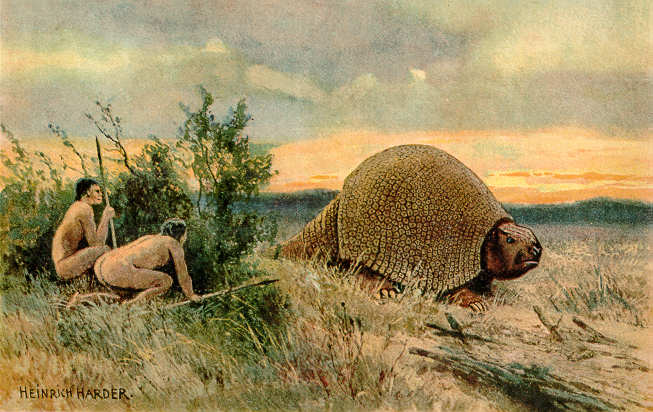 |
By Heinrich Harder (1858-1935) - The Wonderful Paleo Art of Heinrich Harder, Public Domain, https://commons.wikimedia.org/w/index.php?curid=1143767 |
Subscribe to:
Posts (Atom)